



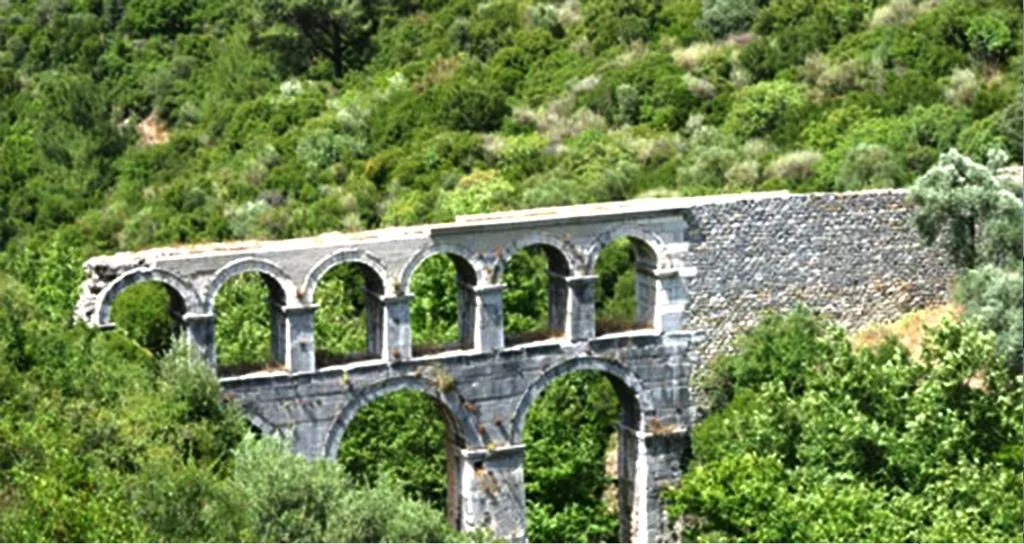
The building inscription on both sides of the aqueduct, in two lines (Latin above, Greek below), records that C. Sextilius Pollio, his wife Ofillia Bassa and his stepson C. Ofillius Proculus built this structure at their own expense in honor of Augustus, Tiberius and the people of Ephesus. The mention of Tiberius shows that the structure was built between AD 4 and 14. The two-tiered aqueduct spans the Dervendere stream, known in antiquity as the Marnas, and its valley with three large arches on the lower tier and six smaller arches on the upper tier. The streambed still runs beneath the eastern arch of the lower tier today.
POLLIO MONUMENT (FOUNTAIN OF DOMITIAN)
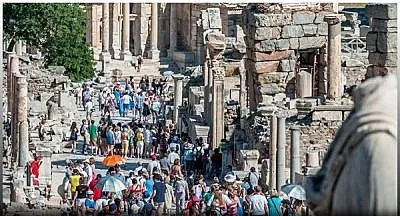
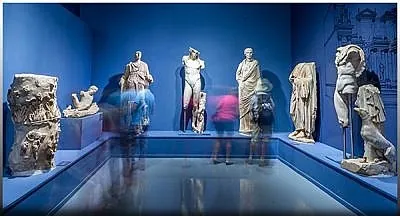
Built on the east side of Domitian Square, adjoining the western edge of the State Agora, this fountain was turned into a monument in memory of Gaius Sextilius Pollio in AD 97, as its inscription shows. A small pool stood in front of the building, whose wide, tall arch has been restored. On the ledge beside the pool were placed reliefs depicting the story of Odysseus and Polyphemus, brought from the pediment of the Temple of Augustus in the middle of the State Agora and now displayed in the Ephesus Museum.
Tomb of Pollio
Built by the people of the city after AD 13 as a monument of gratitude to Gaius Sextilius Pollio, the tomb stands next to the Pollio Fountain on Domitian Square.
TEMPLE OF DOMITIAN
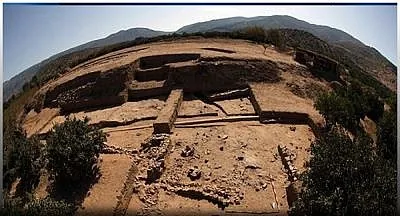
The Temple of Domitian, the first of the city’s imperial cult (neokoros) temples, rose on a terrace. In the period that began with Augustus, who brought about the transition to imperial rule, Roman emperors were deified and many cults were established. Cities with an imperial cult enjoyed special privileges. Of this temple, in use from AD 82 to 391, only the terrace walls and the partly re-erected terrace columns survive today.