


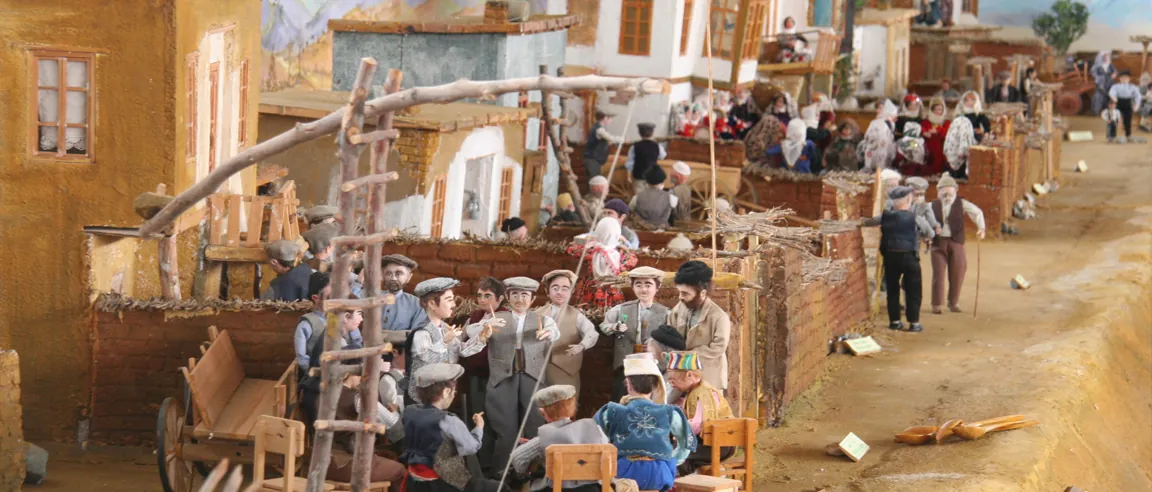
One of the places worth a stop in Selçuk Ephesus, the Çetin Culture Village Museum is 300 meters down the Kuşadası road from the Pamucak–Seferihisar–Kuşadası roundabout.

It is a private museum created by retired teacher Ayhan Çetin and his wife Nazmiye Çetin to keep their childhood memories alive and pass Anatolian culture on to future generations. Opened in 2000, the museum brings the Anatolian village life of the 1950s to life with models, figures, sculptures and paintings. All the works are displayed in an area of 300 square meters. The museum’s founders, Ayhan Çetin and his wife Nazmiye Çetin, proudly exhibit here the fruits of work they have pursued since the 1980s. The figures and paintings in the scenes are the work of Ayhan Çetin, while the costumes and accessories were made by Nazmiye Çetin. The museum particularly reflects the daily life, customs and traditions, and forgotten children’s games of western Anatolian villages. The museum also features scenes from the War of Independence, such as life on the front, ruined and destitute villages behind the lines, convoys carrying food and ammunition to the front, and Elif’s Oxcart. In addition, miniature models bring to life folk dance troupes from different regions of Anatolia, such as Silifke, Ağrı women, Aegean women and Aegean zeybek dancers, Nasreddin Hodja tales such as “Eat, my fur coat, eat” and “He who pays the piper calls the tune,” and scenes depicting the Stone Age.
The Çetin Culture Village Museum has two sections. The moment you step into the garden, you find yourself in a real village setting: village women spinning wool and weaving kilims in one room, blacksmiths hammering iron in another, tinsmiths and farriers in yet another… These life-size models, fitted with moving parts and sound, let visitors experience the past firsthand.
The indoor area, which forms the museum’s second section, portrays Anatolian rituals down to the finest detail: customs such as asking for a bride’s hand, weddings, engagements, seeing off young men to military service, buying the sacrificial animal, bottle shooting, dancing bears and circumcision, as well as making wire cars and toys, herding sheep, plowing fields, working the crops, hunting, milling, tinsmithing, pottery, farriery, women’s preparations for winter, shearing and milking sheep, weaving carpets and kilims, shopping from peddlers and caravans, the mosque and carrying water home.