
EPHESUS, UNESCO’S GOLDEN CITY

Ephesus, the Golden City that was once the capital of the world
Rising in the land where the words kosmos and polites came together to give us the word cosmopolitan, this city also possessed a wisdom that developed the idea of world citizenship.
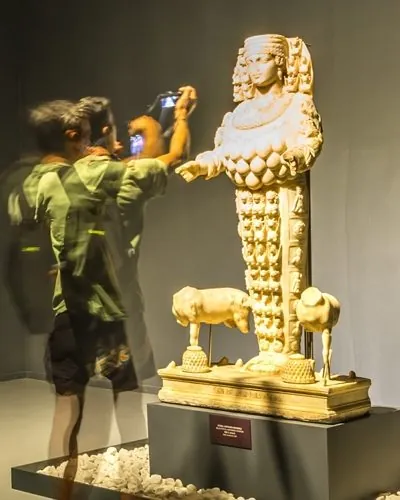
EPHESUS, FOUNDED THOUSANDS OF YEARS AGO… ITS PROTECTORS ALWAYS WOMEN… CYBELE, ARTEMIS AND, LAST OF ALL, SAINT MARY…
One of the few great metropolises of the ancient world, Ephesus was the political, economic and cultural capital of Asia Minor. Even what remains of Ephesus today is proof of what an immense city it was in its time.
As the largest ancient city in Anatolia in terms of the area open to visitors, Ephesus welcomes some two and a half million tourists a year and shows each of them the splendid wealth it enjoyed in antiquity.
AS A PROVINCIAL CAPITAL, EPHESUS WAS A GREAT CITY WHOSE POPULATION REACHED 250,000
Imagine Ephesus in its golden age… Its streets full of colorful people from many different nations: Greeks, Romans, even Egyptians. Ephesus, which drew the people of its day like a giant magnet and enchanted them with its spell; the symbol of abundance, faith and wealth…
Now picture the Agora of such a city… In its golden age the Agora of Ephesus was like a meeting point for the whole world. Here, in a city of 250,000 people, goods arriving from the harbor went on sale and bargains were struck with sailors and merchants from every corner; the Agora also inspired the social thinkers and writers of the day.
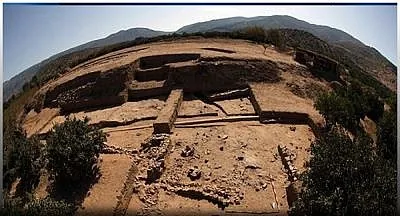
Recent archaeological research on Ayasuluk Hill, northeast of Ephesus and home to what is known today as Selçuk Castle, shows that the area has been settled since around 6000 BC. Surveys and excavations in recent years have revealed traces of Neolithic, Chalcolithic, Bronze Age and Hittite settlement in the mounds around Ephesus and on Ayasuluk Hill, where the castle stands.
A PROVINCIAL CAPITAL BUILT ENTIRELY OF MARBLE
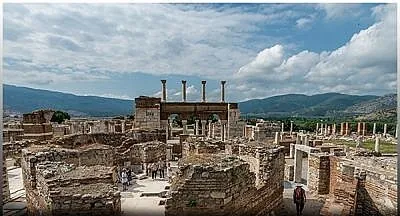
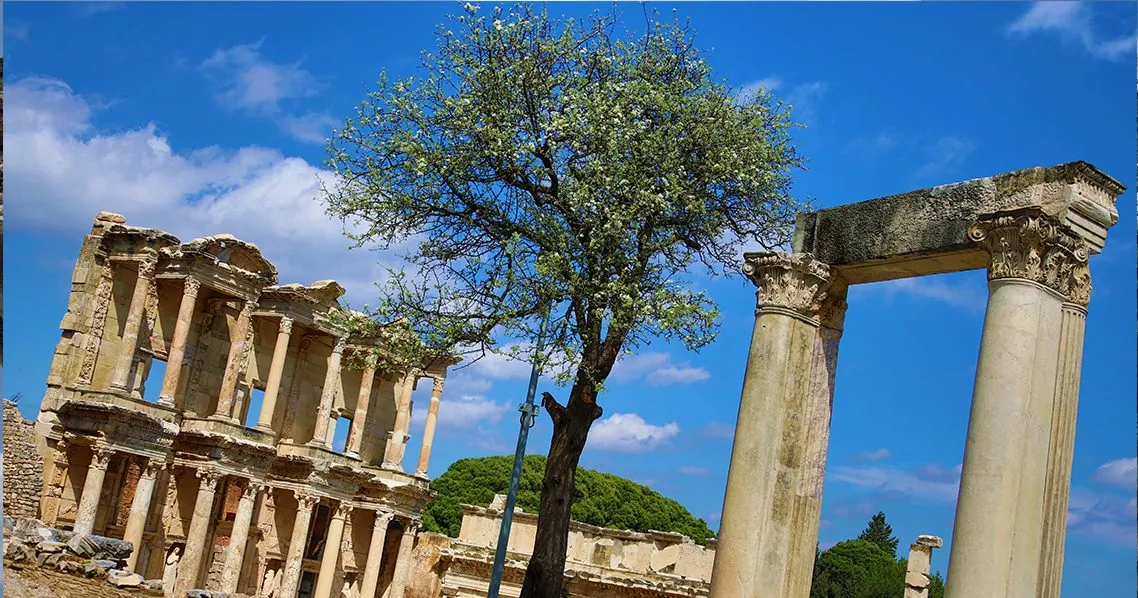
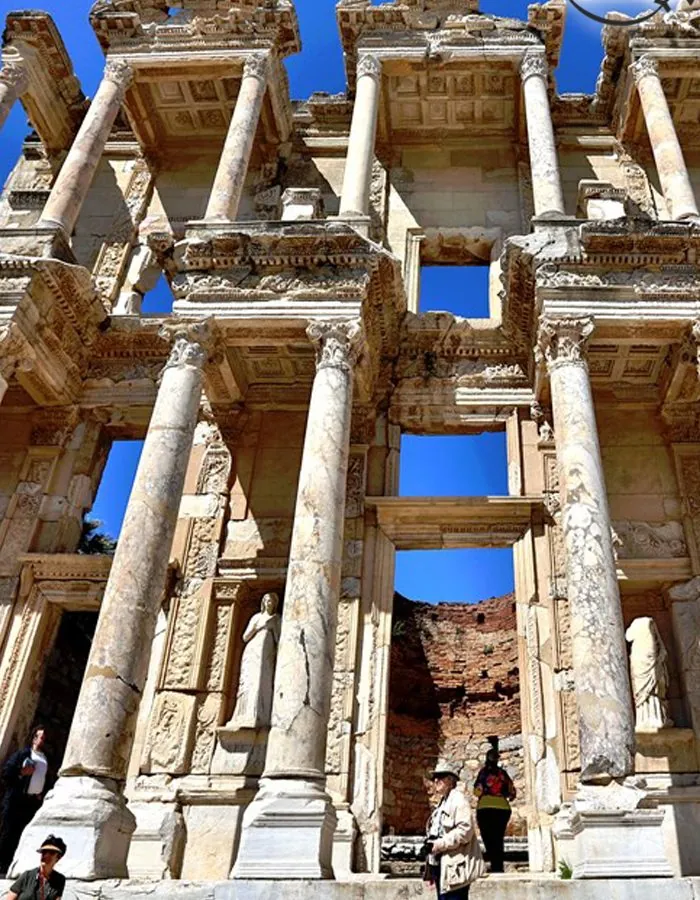
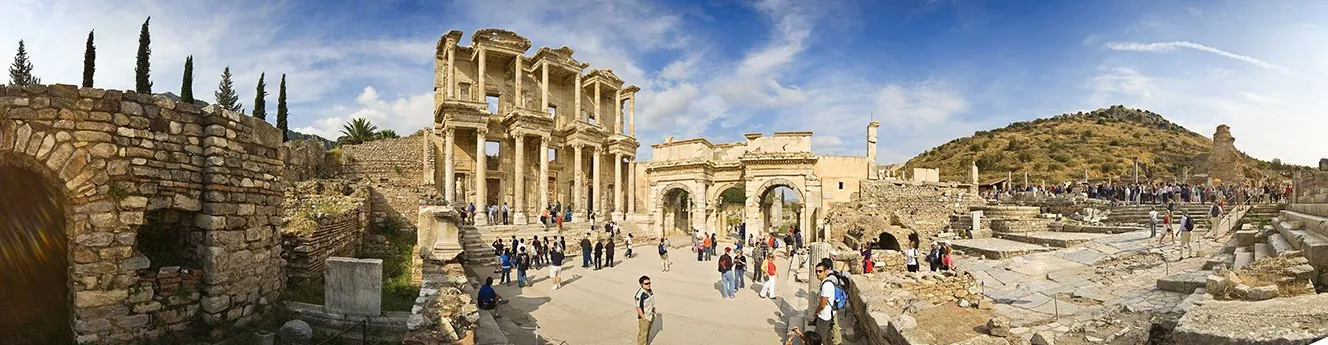
With the Library of Celsus, its giant theater, the Temple of Hadrian, its agoras, baths, House of Love, public latrines, streets and funerary monuments, Ephesus ranks among the most magnificent ancient settlements in the world.
If you enter Ephesus through the Magnesian Gate, you can visit, in order, the Varius Baths, the State Agora, the Odeon, the City Hall, the Water Palace, the Fountain of Pollio, the Memmius Monument, the Temple of Domitian and the Gate of Heracles.
Continuing along Curetes Street, you can see the Fountain of Trajan, the Baths of Scholastica, the Temple of Hadrian, the Terrace Houses, the House of Love, the Library of Celsus, the Commercial Agora, Marble Street, the Theater, the gymnasiums, the baths and the Double Churches.
KEEP YOUR EYES OPEN AS YOU WALK THE STREETS OF EPHESUS: YOU MAY SPOT SYMBOLS THAT HAVE INSPIRED WORLD-FAMOUS BRANDS.
Along the way you will come across the relief of Nike, goddess of victory. The relief dates from the Roman period. With a palm branch in her right hand and a laurel wreath in the left, Nike is the goddess of victory in Greek mythology and is known as Victoria in Roman mythology. The goddess also stands for speed and strength, for Nike could run very fast and fly. Many people are reminded of the world-famous Nike brand, too, and indeed the brand takes its name from Nike, goddess of victory: the name was suggested to the company by Jeff Johnson.
As you explore Ephesus, you cannot help being amazed by the countless stories and legends you hear…
IS THE TOMB OF CLEOPATRA’S SISTER ARSINOE IN EPHESUS?
It is a sad story… Did you know that Cleopatra, the last Hellenistic queen of ancient Egypt, was in fact of Greek descent? Cleopatra, who loved first the Roman statesman Julius Caesar and then, after his death, Mark Antony, ruler of the eastern Roman lands, had a dream just like that of Alexander the Great: dominion over the whole world… That is why she wanted to unite Egypt and Rome. But her sister Arsinoe thought very differently. Believing that this would mean surrendering Egypt to Rome, she stood up to Cleopatra, the elder of the two. Caesar, who backed Cleopatra, sent Arsinoe into exile in Ephesus. There Arsinoe took refuge in the Temple of Artemis, which was protected by its priests, for in those days no one could lay a hand on a temple under the priests’ control. Even so, Arsinoe was killed on the steps of the temple on Mark Antony’s orders. Nothing now stood in Cleopatra’s way. Yet the story of Arsinoe, with a face of rare beauty and a body just as strong, has been told for centuries. Because she was of royal blood, she is thought to have been buried in a monumental tomb in Ephesus: the building known as the Octagon, in front of the Terrace Houses on the south side of Curetes Street. The unusual shape of this octagonal monument in the Corinthian order, set on a square podium 3.40 m high, strikes you at first sight; it is almost a miniature of the Lighthouse of Alexandria in Egypt, Arsinoe’s homeland. That the tomb belonged to Arsinoe, however, is only a hypothesis: the bones found in it were long thought to be those of a young girl, but a DNA study published in 2025 showed that they belonged to a boy aged 11 to 14.
HOMETOWN OF HERACLITUS, THE DARK PHILOSOPHER
Born and raised in Ephesus, where he lived from 535 to 475 BC, this philosopher turned his attention to humankind, society and nature long before Socrates, asking the questions that led him to the doctrine of the unity of opposites. Forefather of many philosophical movements that endured for centuries, Heraclitus is the author of sayings so often repeated that they are thought to be anonymous, such as “you cannot bathe in the same river (waters) twice” and “the only constant is change.” The Ephesian philosopher also offered the books of his thought to the Temple of Artemis as a votive gift; look into his life and we are sure you will find his story fascinating.